Gold reserves vary widely by country, with the United States holding the largest at 8,133 tonnes, followed by Germany at 3,351 tonnes, and Italy at 2,451 tonnes. These stockpiles act as a hedge against inflation and economic unrest, signaling a nation’s distrust in global financial systems. Central banks, like Russia and China, are ramping up purchases amid uncertainty. Gold’s role as a crisis buffer is undeniable. Stick around to uncover deeper insights.
Global Gold Reserves: A Shield Against Uncertainty
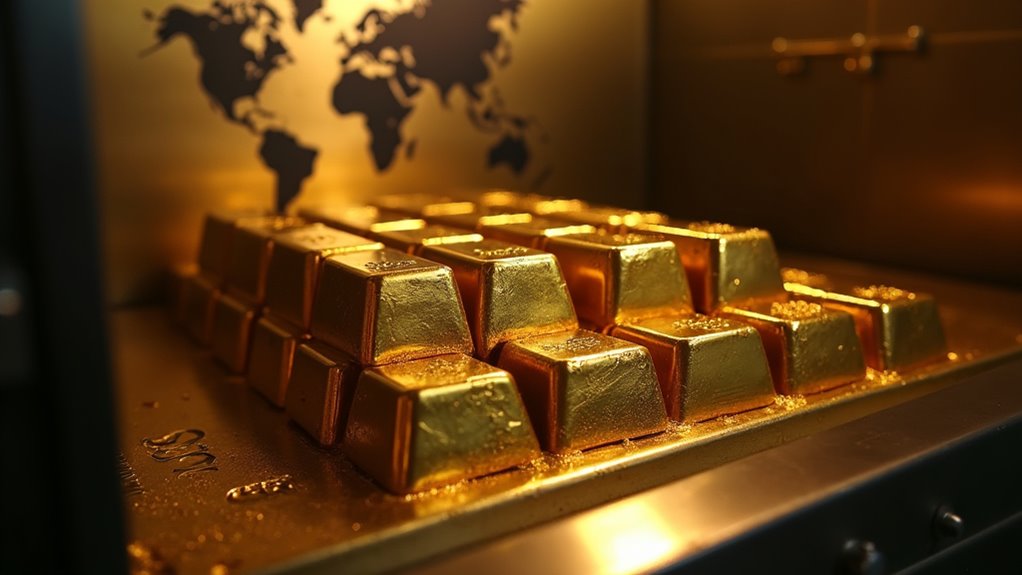
Wealth, in its most enduring form, often glimmers in vaults as gold—a timeless asset nations hoard to shield against economic storms. Across the globe, countries stockpile this precious metal to safeguard against inflation, currency devaluation, and geopolitical unrest. The United States leads with a staggering 8,133.46 tonnes, dwarfing others like Germany at 3,351.53 tonnes and Italy with 2,451.84 tonnes. France and Russia follow closely, holding 2,437.00 and 2,332.74 tonnes respectively, as of June 2024. These reserves aren’t just numbers; they signal a nation’s readiness to weather financial turbulence. Furthermore, the historical context of the classical gold standard provides insight into how these reserves influence modern economic stability.
Gold’s cultural significance throughout history further underscores its role as a reliable asset in times of uncertainty.
The International Monetary Fund (IMF) also holds a hefty 2,814.1 metric tons, a stash that would rank it third among nations if counted in this manner. Its gold, unchanged since 2011, mostly came from member quota payments, though it can’t buy more under current rules. Meanwhile, gold’s share in foreign reserves varies widely—around 75-77% for the U.S., 74% for Germany, and a lower 22-32% for Russia, depending on the data. These percentages, calculated using the LBMA Gold Price, reflect how much a country leans on gold versus other assets like foreign currencies. Investing in gold can be done through various avenues, including physical bullion, ETFs, and mining stocks.

Why cling to gold? It’s a hedge, a store of value that shines brightest in crises. It offers liquidity, diversification, and a buffer against over-reliance on currencies like the dollar or euro. For many, it’s insurance—if fiat money falters, gold can back debts or bolster credibility with trading partners. Central banks have been net buyers for 15 straight years, with record purchases exceeding 1,000 tonnes annually since 2022. In 2024, Poland, Turkey, India, and China snapped up significant amounts, driven by economic and political uncertainty. Emerging markets, from Uzbekistan to India, are bulking up reserves, a trend likely to persist into 2025. Additionally, changes in global gold production trends can significantly influence reserve strategies.
Data on these holdings, often lagged by two months, comes from the IMF’s International Financial Statistics and the World Gold Council. Not all gold sits in its home country—some is stored abroad, and audits are rare, raising questions about transparency. Take Germany, which repatriated much of its gold to Frankfurt from New York and London vaults. Or Russia, aggressively buying since 2014 to pivot away from U.S. dollar assets. Even China, though its gold is just 5.5% of reserves, has ramped up purchases while only recently starting monthly reports.
What does this hoarding reveal? It’s a quiet admission of distrust in global financial systems. Nations like the U.S., storing gold at Fort Knox, or Switzerland with the highest per capita reserves, aren’t just collecting metal—they’re building fortresses of stability. As uncertainties loom, gold remains a universal language of security, a gleaming counterweight to the fragility of paper wealth. Its allure endures, a silent indication of power and precaution in an unpredictable world.