Gold, symbolized as Au, is a rare, dense metal with unmatched malleability and resistance to corrosion, making it a prized material for millennia. Historically, it shaped currencies and economies, from ancient Lydia’s coins to the gold standard’s end in 1971. Today, it dominates jewelry, technology, and investments, with China leading production at over 370 tonnes yearly. Its scarcity—only 0.004 ppm in Earth’s crust—fuels global fascination. Stick around to uncover deeper insights.
Gold’s Unique Properties and Historical Impact
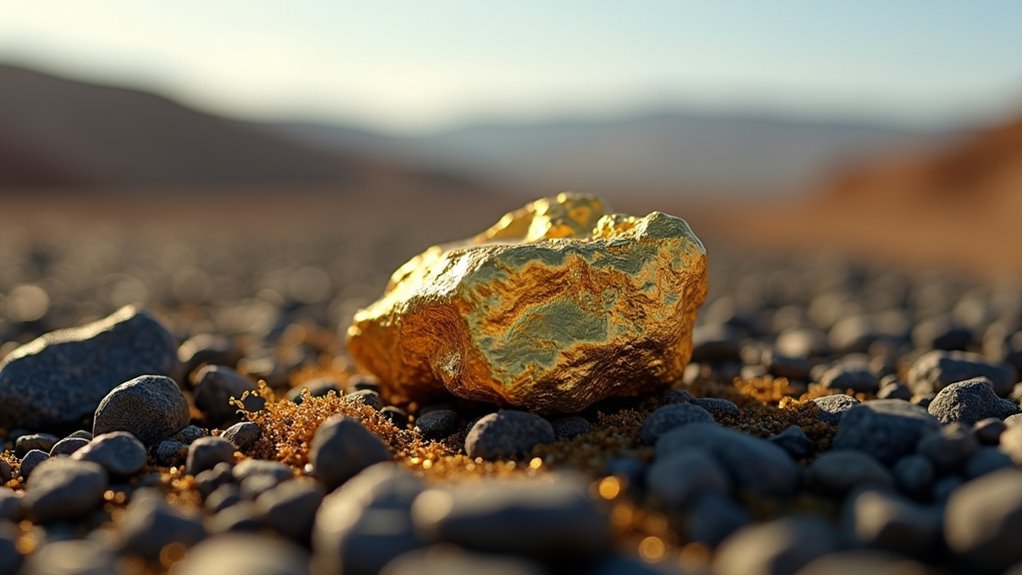
Although gold has captivated humanity for millennia, its allure extends far beyond mere beauty. This precious metal, with the chemical symbol Au and atomic number 79, embodies a rare blend of physical prowess and historical weight. Its density, at 19.3 grams per cubic centimeter, marks it as one of the heaviest metals, while its malleability allows a single gram to be hammered into a square meter of shimmering sheet. Such properties have made it a marvel of nature, found in nuggets and grains across every continent, though its scarcity—merely 0.004 parts per million in Earth’s crust—underscores its value. Even more elusive is a one-ounce gold nugget, rarer than a five-carat diamond, a fact that fuels its mystique. Additionally, gold mining involves multiple stages that contribute to its journey from the earth to the market.
Gold’s durability is equally striking. As a noble metal, it resists corrosion, tarnish, and rust, standing unaffected by air, water, or most acids, save for the potent mix of aqua regia. This resilience, paired with its conductivity, guarantees it remains a staple in technology, from electrical connectors to infrared shielding in spacecraft. Its only stable isotope, Au-197, further cements its unyielding nature. Moreover, investing in gold can take various forms, reflecting diverse risk profiles and market strategies.
Yet, for all its strength, pure 24-karat gold is soft, often alloyed with copper or silver to craft durable jewelry or coins, with purity measured in karats—18k signaling 75% gold content. This balance of toughness and workability has kept it central to human craft for ages.

Historically, gold’s gleam shaped economies and empires. Used since prehistoric times for art and adornment, it became currency by 700 BC in Lydia, forged into electrum coins. It underpinned monetary systems via the gold standard, though that framework largely dissolved after 1971’s Nixon Shock.
Today, its role persists in central bank reserves, holding 17-21% of annual demand for economic stability, while jewelry consumes nearly half. Investment in bars and coins, alongside tech uses, rounds out its modern footprint, reflecting a timeless trust in its worth.
Global production tells a story of scale and shift. By 2024, roughly 216,265 tonnes have been mined—enough to fill a 22-meter cube—with two-thirds extracted since 1950 due to tech advances. China leads output at 370-380 tonnes yearly, followed by Russia and Australia, while South Africa, once dominant with a 1970 peak of 1,002 tonnes, has waned. Gold production trends indicate shifts in global supply and demand dynamics.
Reserves remain vast, with Australia holding 12,000 tonnes underground. Yet, an estimated 15,000-20,000 tonnes lie dissolved in oceans, tantalizingly out of reach.

Gold’s saga is one of rarity, resilience, and reverence. It conducts, it endures, it symbolizes. Its scarcity drives desire, its properties enable progress, and its history mirrors human ambition. From ancient veins to modern circuits, gold remains a quiet power, shaping wealth and wonder with unassuming might.