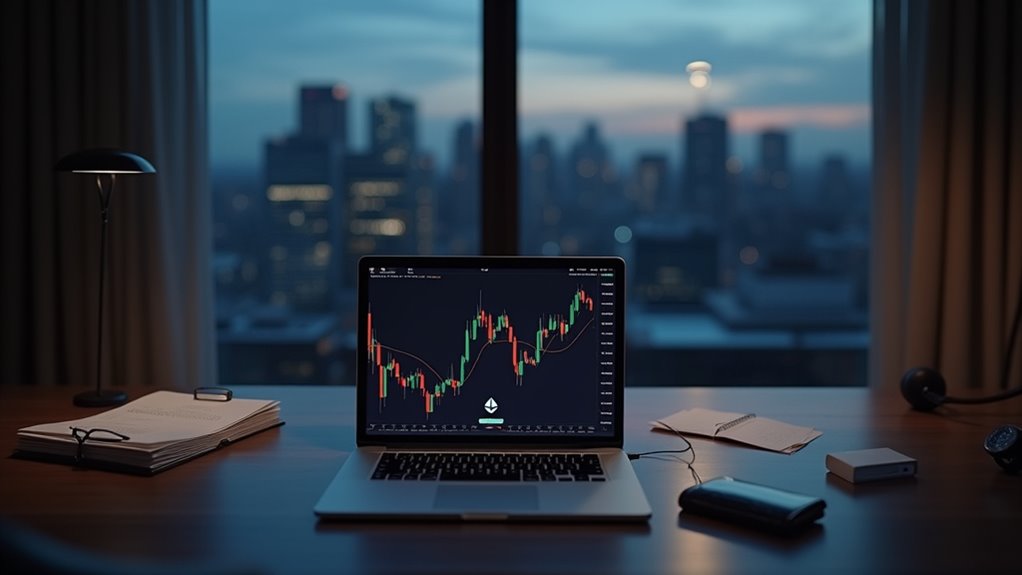
In crypto, a whale is an individual or entity holding massive amounts of digital assets, often enough to sway market dynamics. Their trades can spike prices with huge buys or crash them with heavy sells, creating waves of volatility. Tools like Etherscan track their moves, revealing patterns of influence. Whales wield power, sometimes skewing markets through strategic plays. Their impact is undeniable, shaping trends. Stick around to uncover deeper insights into their strategies.
Crypto Whales: Market Movers of Digital Assets

Behemoths of the digital domain, crypto whales are individuals or entities wielding vast holdings of cryptocurrency, enough to sway market tides with a single move. These titans, whether early adopters, institutions, or even governments, possess enough digital assets to influence prices and liquidity. For Bitcoin, a whale might hold over 1,000 BTC, though thresholds vary across cryptocurrencies. Much like institutional investors in traditional markets, their presence looms large, shaping the volatile landscape of decentralized finance with every transaction they make. Stablecoins can also play a role in how these whales execute their strategies without causing significant market disruption. Additionally, the emergence of crypto ETFs has provided a new avenue for investors to gain exposure to these assets without direct ownership. Cryptography plays a vital role in ensuring the security of these transactions, allowing whales to maneuver within the market with confidence.
Their power lies in sheer volume. A massive buy order can spike demand, pushing prices upward in a phenomenon often called a “pump.” Conversely, a hefty sell order, or “dump,” floods the market with supply, dragging prices down. Such moves often spark volatility, unsettling smaller investors—sometimes dubbed “minnows”—who react to the ripples. Whales can even orchestrate artificial demand or supply through coordinated actions, using tactics like sell walls to depress prices before buying low, or buy walls to inflate them before selling high. When news of their trades spreads, often via platforms like Whale Alert, the market’s response can amplify, turning a single move into a tidal wave. To navigate this turbulent environment, many investors turn to reliable crypto platforms to ensure they can safely execute their trades.
Crypto whales wield immense power, sparking volatility with massive buys or sells, manipulating markets through strategic walls, and amplifying moves via platforms like Whale Alert.
Liquidity, too, bends to their will. By holding vast sums dormant, whales shrink circulating supply, making markets thinner and trades trickier for smaller players. Yet, when they act, liquidity surges—large sell-offs briefly ease trading, while buys can tighten it further. This dual nature means their influence cuts both ways, enabling big trades but also skewing the playing field. It’s a pattern worth watching: concentrated power in few hands often breeds uneven outcomes, and the crypto space is no exception.

Tracking these giants is possible thanks to blockchain’s transparency. Tools like Etherscan or Nansen let anyone monitor large wallet addresses and transaction histories. Real-time alerts from platforms like Whalemap reveal when whales shift funds, while metrics such as the Exchange Whale Ratio hint at their next steps by analyzing inflows and outflows. Patterns emerge—frequency, volume, timing—all offering clues to their strategies. It’s not speculation but observation, a way to glimpse the undercurrents driving market sentiment.
Notable whales include Bitcoin’s elusive creator, Satoshi Nakamoto, believed to hold around 1 million BTC, largely untouched. Others, like Michael Saylor or the Winklevoss twins, alongside corporations such as MicroStrategy, wield significant stakes. Exchanges like Binance and governments like El Salvador also join the ranks, their holdings a mix of strategy and circumstance.
For everyday investors, tracking whale activity offers insight into potential trends, though it’s no crystal ball. Their moves signal shifts, but the why often remains opaque. What’s clear is their outsized role—power concentrated in digital vaults, shaping a market still finding its footing. If there’s a question to ask, it’s how much sway is too much in a space built on decentralization.
Frequently Asked Questions
How Do Crypto Whales Acquire Their Large Holdings?
Crypto whales build their vast holdings through diverse, calculated methods. They often engage early in projects, acquiring assets at low prices or mining during less competitive times.
Large-scale purchases during market dips, OTC trades, and gradual accumulation are common. Some gain tokens as founders or through venture capital.

Institutional investments and sophisticated trading, like arbitrage, also play a role. Their strategies, while varied, consistently leverage scale and timing.
What Motivates Crypto Whales to Manipulate Markets?
Examining what drives market manipulation reveals a clear pursuit of profit and control.
Motives often center on maximizing gains through tactics like price inflation or crashing values for cheap buy-ins. Some exploit information gaps or retail trader emotions, capitalizing on fear or hype.
Others shape narratives via false signals or coordinated moves. Power is wielded strategically, and patterns of self-interest emerge—always aimed at tilting the market’s balance in their favor.
Are Crypto Whales Regulated by Any Authorities?

Regulatory oversight of large crypto asset holders is evolving, though it remains inconsistent.
In the U.S., the CFTC and SEC enforce anti-fraud and manipulation rules, targeting suspicious activities in virtual currency markets.
Internationally, Dubai’s VARA is pushing for disclosure of major token holders to boost transparency.
Yet, the pseudonymous nature of transactions complicates enforcement, leaving gaps in regulation.

Authorities are tightening scrutiny, but challenges persist in holding power accountable.
How Can Small Investors Identify Whale Activity?
Small investors can spot whale activity by using blockchain explorers like Etherscan to track large transactions and monitor wallet balances for unusual patterns.
They might also check exchange data for big buy or sell orders and use tools like Whale Alert for real-time alerts.
Social media buzz on Twitter can hint at moves, while correlating odd volume spikes with news offers clues.

Stay curious, verify data, and dig deep.
Do Crypto Whales Collaborate With Each Other?
Do crypto whales collaborate with each other? Evidence suggests they often do, forming private groups on platforms like Telegram or Discord to coordinate actions.
Blockchain data sometimes reveals synchronized wallet movements, hinting at planned buying or selling. Their goal appears to be maximizing profits through tactics like pump-and-dump schemes.
Such collaboration can distort markets, and while not always visible, patterns of influence raise questions about fairness and integrity.